The Role of Physiotherapy in Cerebral Palsy (CP) Rehabilitation: Goals, Methods, and Home Support
Cerebral palsy (CP) is one of the most common movement and posture disorders seen in childhood. When most families hear the diagnosis, they first look for answers to questions like “what is cerebral palsy?”, “is CP treatment possible?”, and “how long does cerebral palsy rehabilitation take?”. Let’s start with an important piece of information here: CP is not a progressive (worsening) disease; however, the child’s growth, the development of the musculoskeletal system, and posture and movement habits can change over time. Therefore, rehabilitation that is planned from an early stage and followed regularly plays a critical role in increasing the child’s functional independence.
Physiotherapy is the cornerstone of cerebral palsy rehabilitation. The aim is not just to “do exercises”; it is to enable the child to move more comfortably in daily life, to safely develop skills such as sitting, standing, and walking, to manage spasticity, to preserve joint range of motion, and to reduce pain. This article is for informational purposes; specifically, CP physiotherapy movements and home program examples are not the same for every child. A personalized plan must be made with a pediatric physiotherapist’s evaluation.
What is Cerebral Palsy (CP)? Types and Impact on the Child’s Movement
The shortest answer to the question “What is cerebral palsy?” is: It is a permanent movement and posture disorder that develops due to an injury to the areas of the brain that control movement, usually occurring before birth, during birth, or in early infancy. CP is not a single clinical picture; the area of impact and severity can vary from child to child. Therefore, cerebral palsy rehabilitation is not a “one-size-fits-all” program, but a personalized roadmap.
The most common type of CP is spastic CP. Spasticity, described by the public as “stiffness/tightness in muscles,” can reduce the fluidity of movement, increase the load on joints, and over time increase the risk of shortening (contracture). For this reason, when " treatment for a spastic child" is mentioned, it should not only be thought of as muscle relaxation; but posturology, balance, strength, functional movement training, and if necessary, orthosis/assistive device management should be considered together.
Other types include dyskinetic CP (involuntary movements, fluctuating muscle tone) and ataxic CP (balance and coordination difficulties). Additionally, subgroups such as hemiplegia (one side of the body), diplegia (especially the legs), and quadriplegia (four extremities and the trunk) can be seen depending on the distribution of the impact. In physiotherapy, goals are determined according to this type and the child’s functional level.
Cerebral Palsy Rehabilitation and CP Treatment: Fundamental Goals of Physiotherapy
Families searching for “CP treatment” are often looking with the expectation of “will it go away completely?”. In CP, the concept of “treatment” usually refers to multidisciplinary management: fields such as child neurology, orthopedics, physical therapy and rehabilitation, pediatric physiotherapy, occupational therapy, speech and language therapy, nutrition, and psychological support work together. Within this team, the role of physiotherapy is to improve the child’s movement skills and prevent secondary problems.
What are the measurable goals in physiotherapy?
In cerebral palsy rehabilitation, goals are generally gathered under the following headings:
- Posture and alignment: Increasing head and trunk control, making the sitting position more stable.
- Spasticity management: Positioning aimed at reducing tone, appropriate stretching strategies, and tone control within functional movement.
- Preserving joint range of motion: Reducing the risk of shortening/contracture, especially in the hip, knee, and ankle.
- Strength and endurance: The myth that “strength training increases spasticity” is not true for every child. Strengthening done with the right dose and technique supports function.
- Balance and coordination: Reducing falls, increasing movement safety.
- Walking and transfer skills: Sit-to-stand, transfer from bed to chair, stairs, walking efficiency.
- Pain and fatigue management: An important area that determines quality of life in the long term.
These goals are planned based on clinical tests, observation, family interviews, and the child’s daily life performance. While walking may be a priority for some children, for others, comfortable sitting and positioning that reduces the risk of pressure sores may be more critical.
Physiotherapy Methods Used in CP: Evidence-Based Approaches and Who They Suit
Cerebral palsy rehabilitation does not proceed through a “single method.” The best results are obtained by combining methods selected according to the child’s needs with functional goals.
Commonly used approaches
- Task-oriented training: Teaches skills the child needs in daily life (e.g., sit-to-stand, taking a step, balance) through repetition and problem-solving.
- Bobath Therapy / NDT: Focuses on tone regulation, postural control, and supporting movement quality. It is frequently used especially in structuring movement experience in the early period.
- Strengthening and conditioning studies: Muscle strength and endurance can be increased with appropriately selected exercises; this contributes to walking efficiency and fatigue management.
- Balance and coordination training: Supported by game-based applications such as balance boards, ball activities, and controlled movement on different surfaces.
- Stretching, serial casting, positioning: Can be applied with a plan from the physician and physiotherapist in muscle groups with a tendency to shorten.
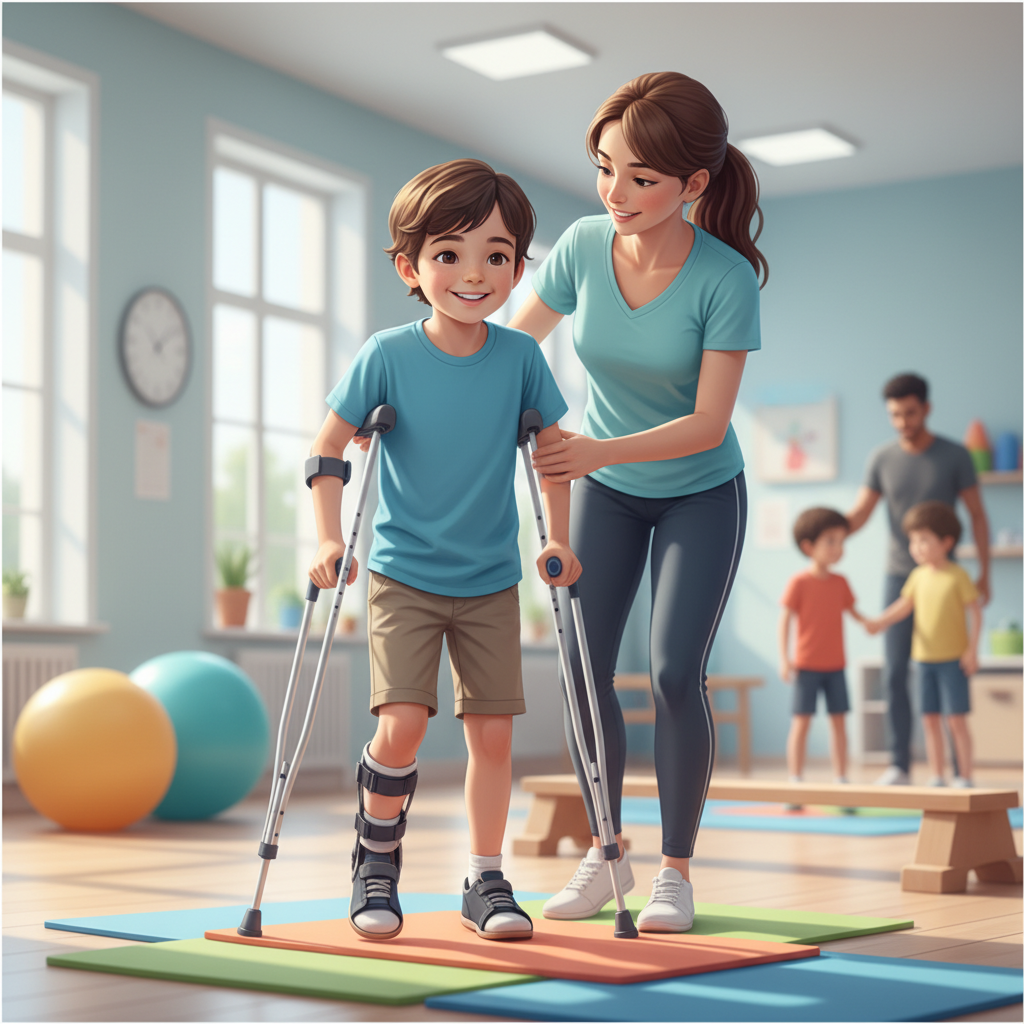
- Orthoses and assistive devices: Orthoses like AFOs, and devices like walkers/crutches/wheelchairs can increase function.
- Aquatic therapy (hydrotherapy): Can facilitate movement by reducing joint load in suitable children.
Physiotherapy after interventions like Botox/surgery
For some children, botulinum toxin (Botox) or orthopedic interventions may be on the agenda for spasticity management. Such interventions are not sufficient on their own; new movement patterns must be taught through physiotherapy to carry the targeted gain into daily life.
Planning According to GMFCS Level and CP Physiotherapy Movements: Principles of Safe Home Support
One of the issues families struggle with the most is the question “What should we expect?”. At this point, the GMFCS (Gross Motor Function Classification System) helps clinicians classify the child’s gross motor skills. GMFCS is not a “label”; it is a tool for goal setting and realistic planning.
General framework: Goals according to GMFCS
- GMFCS I–II: Balance, quality of running and jumping, walking efficiency, sports/play participation, fine-tuned posture control.
- GMFCS III: Mobility with walking aids, transfer independence, energy efficiency, orthosis and device compliance.
- GMFCS IV–V: Comfortable and safe positioning, reducing pressure sore risk, preventing contractures, respiratory support, caregiver ergonomics, increasing communication and participation.
Safe principles for families looking for “CP physiotherapy movements”
A home program is the carrying over of goals learned in the clinic to daily life. However, in CP, incorrect techniques can increase muscle tone or place excessive load on joints. Therefore, the following suggestions should be considered as general principles:
1) Positioning: “Therapy” all day long
- Reduce staying in the same position for a long time.
- Pay attention to hip and trunk alignment in sitting; use sitting support/appropriate chairs if necessary.
- Apply the side-lying/supine arrangements recommended by the physiotherapist during sleep or rest.
2) Balance and weight shifting through play
- Weight shifting games like “reaching for a toy” to the right and left during supported standing.
- Games that encourage using two hands while sitting on the floor and require rotating the trunk (rolling a ball, stacking blocks).
- Controlled movement experience on different surfaces (carpet, cushion).
3) Functional repetition: Embedded in daily routine
- Adding sit-to-stand work to “every toilet/table time” routine with small repetitions.
- Performing transfers (bed-chair) with the child’s active participation as much as possible.
- Safety priority in activities like stairs/going up and down: handrails and close supervision.
4) Stretching and range of motion: Pain-free and controlled
- Stop if there is pain, grimacing, breath-holding, or excessive resistance during stretching.
- The approach “it opens better if forced more” is not correct. Duration/intensity is determined according to the child.
Red flags: In cases such as significant pain after exercise, increased stiffness, new onset of limping, redness/injury on the skin, excessive fatigue, or disruption in sleep patterns, stop the program and consult a specialist.
Frequently Asked Questions for Families and Choosing a Center in the area
Does CP go away completely?
The brain-based impact of CP is permanent; however, with correct cerebral palsy rehabilitation, function, independence, and quality of life can be significantly increased. The goal is to reveal the “maximum potential.”
How many days a week should physiotherapy be?
There is no single correct number. The child’s GMFCS level, goals, school schedule, fatigue level, and family resources are taken into account. Often, a combination of clinical sessions + a home program is the most sustainable approach.
What should I look for when choosing a cerebral palsy center in the area?
Practical criteria for families looking for a “cerebral palsy center in the area”:
- Pediatric physiotherapy experience and regular measurement-evaluation (goal tracking)
- Multidisciplinary cooperation (occupational therapy, orthosis/device consultancy, physician coordination)
- Family education and home program follow-up
- A game-based approach that increases the child’s motivation
- Accessibility and continuity of sessions (sustainable plan)