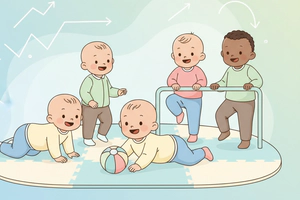
Movement Training and Physiotherapy for Children with Autism: Exercise Guide Supporting Motor Skills
In children with Autism Spectrum Disorder (ASD), alongside social communication and behavioral areas, differences can also be seen in areas such as motor development, balance, coordination, and body awareness. These differences do not manifest the same way in every child; while some children have a very active and “constantly running” profile, others may avoid movement or struggle to plan a new movement. At this very point, creating an exercise for children with autism plan is a powerful tool to support the child’s daily living skills and increase their participation.
In this article, we will discuss the movement training for children with autism approach and how autism physiotherapy practices are structured. You will also find the relationship between “autism and sports,” a list of autism physical activities that can be applied at home/school, adaptations according to sensory profiles, and safety tips.
Note: This content is for informational purposes only; it does not substitute for diagnosis/treatment. If your child has pain, frequent falls, significant posture disorders, or additional neurological symptoms, it is important to consult a pediatric physiotherapist and the relevant physician.
Why Might Motor Skills Be Affected in Autism?
The topic of “motor skills in autism” is being discussed more in recent years; because difficulties in the motor area can directly affect daily living areas such as play initiation, peer participation, and self-care. There are several common reasons why motor skills are affected in ASD:
- Motor planning (praxis) difficulty: The child knows what they want to do but may struggle with starting the movement, sequencing, and adapting to a new movement. For example, they may know how to kick a ball, but establishing the “run-approach ball-adjust foot-kick” chain might be difficult.
- Balance and postural control: When trunk (core) stability is weak, skills like sitting, climbing stairs, or standing on one foot can become difficult.
- Bilateral coordination: Difficulties can be seen in activities requiring both sides to work together (using scissors, catching-throwing, jumping rope).
- Sensory processing differences: Vestibular (balance), proprioceptive (joint-muscle awareness), and tactile system differences, frequently emphasized under the title “sensory integration autism,” can turn movement into either a highly sought-after or avoided experience.
- Endurance and rhythm: Some children get tired quickly or struggle with keeping rhythm and adjusting their tempo.
The good news is: Motor skills can be worked on and improved. Regular, goal-oriented movement training planned at a level suitable for the child can support both motor development and behavioral regulation.

What Does Physiotherapy Provide in Autism? (What is the Difference from Sports?)
When “autism and sports” is mentioned, branches like swimming, gymnastics, and football usually come to mind. Sports are very valuable; however, physiotherapy and sports are not the same thing. Physiotherapy in autism is a clinical process that evaluates the child’s current motor capacity, sets measurable goals, selects exercises with scientific principles, and tracks progress.
What is done in physiotherapy?
- Evaluation: Balance, coordination, muscle strength, range of motion, posture, gait pattern, gross motor skills, and functional participation are examined.
- Goal setting: Measurable goals are set instead of “getting better.” E.g., “Standing on one foot for 10 seconds at the end of 4 weeks,” “Climbing stairs without holding on,” “Catching a ball 5 times consecutively.”
- Programming: An exercise program for children with autism is created considering the child’s age, developmental level, sensory profile, motivation sources, and family routine.
- Adaptation and education: The home program is taught to the family; goals can be shared with the school/special education team.
- Follow-up: Exercises are made harder or simpler according to the child’s progress.
When should one consult a physiotherapist?
- Frequent falling, significant clumsiness, difficulty on stairs
- Toe walking, significant posture disorder
- Loss of balance, coordination difficulty, avoiding ball games
- Excessive inactivity or getting tired quickly during movement
- Pain, suspicion of joint laxity/hypermobility
At this point, for more information regarding balance and coordination, this content may also be helpful: How to Understand Balance and Coordination Problems in Children?
Exercise and Movement Training for Children with Autism: Examples Applicable at Home/School
The following suggestions aim for the practicality most needed by families looking for “autism physical activities.” The basic principle in exercises: short duration + frequent repetition + clear start-finish + visual support + gamification.
1) Daily 10–15 minute sample routine (at home)
Warm-up (2–3 min)
- Animal walks: bear walk, crab walk (20–30 sec + rest)
- “Wall push”: 10 repetitions (provides proprioceptive input)
Main part (7–9 min)
- Balance: Walking on a line (make a line with tape in the hallway) 3 laps
- Coordination: Ball rolling-catching (start sitting on knees) 10 repetitions
- Core: Bridge (supine hip lift with knees bent) 6–10 repetitions
- Bilateral skill: Throwing ball into a basket overhead with two hands 8 repetitions
Cool-down (2–3 min)
- Deep breath + “balloon blowing game”
- Instead of slow rocking (in those with vestibular sensitivity), “rolling” on the floor might be tolerated better.
2) 5-minute micro movements at school/recess
- Wall push-ups 10 repetitions
- Sit-to-stand from chair 8 repetitions
- “Cross touch”: right hand-left knee, left hand-right knee 10 repetitions
- Mini obstacle course: walk 3 steps + touch cone + return
3) Active games applicable at the park
- Climbing (safe height, adult supervision)
- Swing: provides regulation in some children, may overstimulate others (try gradually)
- Hopscotch: rhythm + balance
- Chase-catch ball: rolling first, then throwing through the air
Selecting exercises according to target skill (mini guide)
- For Balance: standing on one foot, walking on a line, standing on a cushion
- For Coordination: ball games, cross walking, stepping with rhythm
- For Trunk control (core): bridge, plank variations, crawling through tunnel
- For Motor planning: 2–3 step directive courses (“jump–turn–touch ball”)
You can also review this article explaining the physiotherapy-play combination to gamify exercises: Combining Play Therapy and Physiotherapy: How Do Children Recover?
The Relationship Between Sensory Integration (Autism) and Movement: Adaptation According to Sensory Profile
The reason for the increase in “sensory integration autism” searches is that many children focus better with movement or, conversely, get overstimulated. Movement can support regulation when given in the right dose.
Frequently seen profiles and practical adaptations
- Proprioceptive seeking (deep pressure need):
Jobs involving “pushing-pulling-carrying” are good. E.g., wall push, carrying heavy pillows, pushing toy box. - Vestibular sensitivity (spinning/swinging difficult):
Instead of fast spinning, sudden swing movements; crawling on the floor, passing through a tunnel, slow-paced walking might be a safer start. - Hyperactivity and impulsivity:
Session/home routine might be better tolerated in the order of “heavy work first (proprioceptive) → then balance/coordination → calming last.” - Avoidance of movement:
Start with very simple goals: 30-second tasks, obstacle course with favorite toy, activities that make success felt quickly.
To understand sensory symptoms more deeply: Sensory Processing Disorder Symptoms and Treatment Methods
Safety, Red Flags, and Common Mistakes
When planning exercises for children with autism, safety is at least as important as the content of the program.
Points to consider
- Pain: Do not force if there is pain during/after exercise.
- Dizziness, nausea: There may be sensitivity to vestibular stimuli; reduce spinning/swinging.
- Shortness of breath and excessive fatigue: Shorten the duration, add rest breaks.
- History of epilepsy: The program must be planned in coordination with the physician and physiotherapist.
- Suspicion of joint laxity/hypermobility: Controlled strengthening is preferred over excessive stretching.
Common mistakes
- Making an excessively intense program thinking “if they move a lot, they will sleep better”
- Continuing activities like fast swinging/spinning for a long time without considering the child’s sensory profile
- Trying “different exercises every day” without setting success criteria (routine and repetition facilitate learning)
- Focusing only on the sports branch and neglecting basic motor components (core, balance, coordination)