0-12 Month Baby Motor Development Stages: Month-by-Month Baby Development Chart + Tummy Time and Supportive Games
Your baby’s first year contains many “firsts” such as head control, rolling, sitting, crawling, and first steps. During this process, the most frequently asked questions by parents are “When does a baby crawl?”, “At how many months does a baby roll/sit/walk?”, and “What can I do at home for baby motor development?”. The good news is: Although motor development follows a specific sequence, every baby progresses at their own pace, and small differences are often normal.
In this article; with the logic of a 0-12 month baby development chart, we will explain the gross motor skills stages (from head control to walking) month by month. We will also include baby motor development games that can be applied at home for each period, safe and effective tummy time exercises, pre-crawling signs, normal variations, and critical red flags such as “when to consult a specialist?”. We aim to offer a practical roadmap for supporting development by reminding of the importance of the “corrected age” concept, especially in premature babies.
What is Baby Motor Development? (Distinction Between Gross Motor Skills and Fine Motor)
Baby motor development is the process of the baby learning to move. This process is handled under two main headings:
- Gross motor skills: Movements made using large muscle groups. Head control, lifting the torso in a prone position, rolling, sitting, crawling, standing up, and walking fall into this group.
- Fine motor skills: Related to hand-finger control and eye-hand coordination. Covers skills such as grasping a toy, transferring between two hands, and holding small objects.
The focus of this article is gross motor skills and the games that support them; however, remember that as gross motor advances, fine motor and sensory development often strengthen together.
“Corrected age” note for premature babies
If your baby was born early, corrected age is used as recommended by your doctor when evaluating development milestones. This reduces unnecessary anxiety and provides a more realistic follow-up.
0-12 Month Baby Development Chart (Month-by-Month Gross Motor Stages) + Game Suggestions
The list below is prepared to answer “baby development chart month by month” searches. Each item describes “expected” ranges; deviations of a few weeks are mostly normal.
0-1 Month
Expected:
- Short-term head turning to the side, very short head lifting attempts while prone
- Reflexes are prominent
Games to support baby development:
- Tummy time on chest: Lay the baby prone on your chest; 30-60 second mini attempts.
- Face-to-face talking: Talk from a close distance so they turn their head towards your voice.
2-3 Months
Expected:
- Head control increases, weight bearing on forearms begins in prone position
- Attempts to roll from back to side may be seen
Games:
- Contrast card tracking: Short-term visual tracking in prone position.
- Tummy time with rolled towel support: More comfortable position by placing a thin roll (towel) under the chest.
4-5 Months
Expected:
- Rolling (tummy-to-back or back-to-tummy) may begin
- Sitting supported by hands, weight transfer attempts
Games:
- Side-lying play: Lay the baby on their side and extend the toy to both sides (prevents asymmetry).
- Encouraging rolling: Create rolling motivation by placing the toy slightly to the side.
6 Months
Expected:
- More balanced sitting (short-term unsupported sitting can be seen)
- Using arms stronger in prone position, attempts to push backward/forward
Games:
- Reach-and-grab while sitting: Place the toy slightly to the side/front while sitting to encourage reaching.
- “Airplane” in prone: Strengthening arms by supporting the baby’s torso for a short time.
7-8 Months
Expected:
- Rolling is more fluid, pivot (turning around self on tummy)
- Preparation for creeping or crawling (pulling knees, rocking back and forth)
Games:
- Tunnel game: Make a short “tunnel” with pillows and encourage moving towards the target.
- Four-point preparation: Standing on knees-hands for a short time with support under the torso.
9-10 Months
Expected:
- Crawling begins in many babies (variations like classic crawling, bear walk, creeping may exist)
- Pulling to stand, preparation for side stepping while holding onto furniture
Games:
- Crawling course: Small obstacles with cushions/pillows.
- Target at height: Encouraging rising by holding on by placing a favorite toy on the sofa edge.
11-12 Months
Expected:
- Cruising (walking while holding on), standing independently for a short time
- Independent steps in some babies
Games:
- “Come here” game: Safe calling between two parents at a very short distance.
- Balance game: Squatting-standing up by holding onto low, wide-based supports.
“When does a baby crawl?” (Short, clear answer)
Most babies start crawling between 7-10 months. However, some babies creep first, some do the “bear walk”, and some may switch to walking without crawling. What is important is that the baby moves in a symmetrical way, can perform weight transfer, and their movement repertoire for exploring the environment increases.
Tummy Time Exercises: When to Start, How Many Minutes a Day, How to Facilitate?
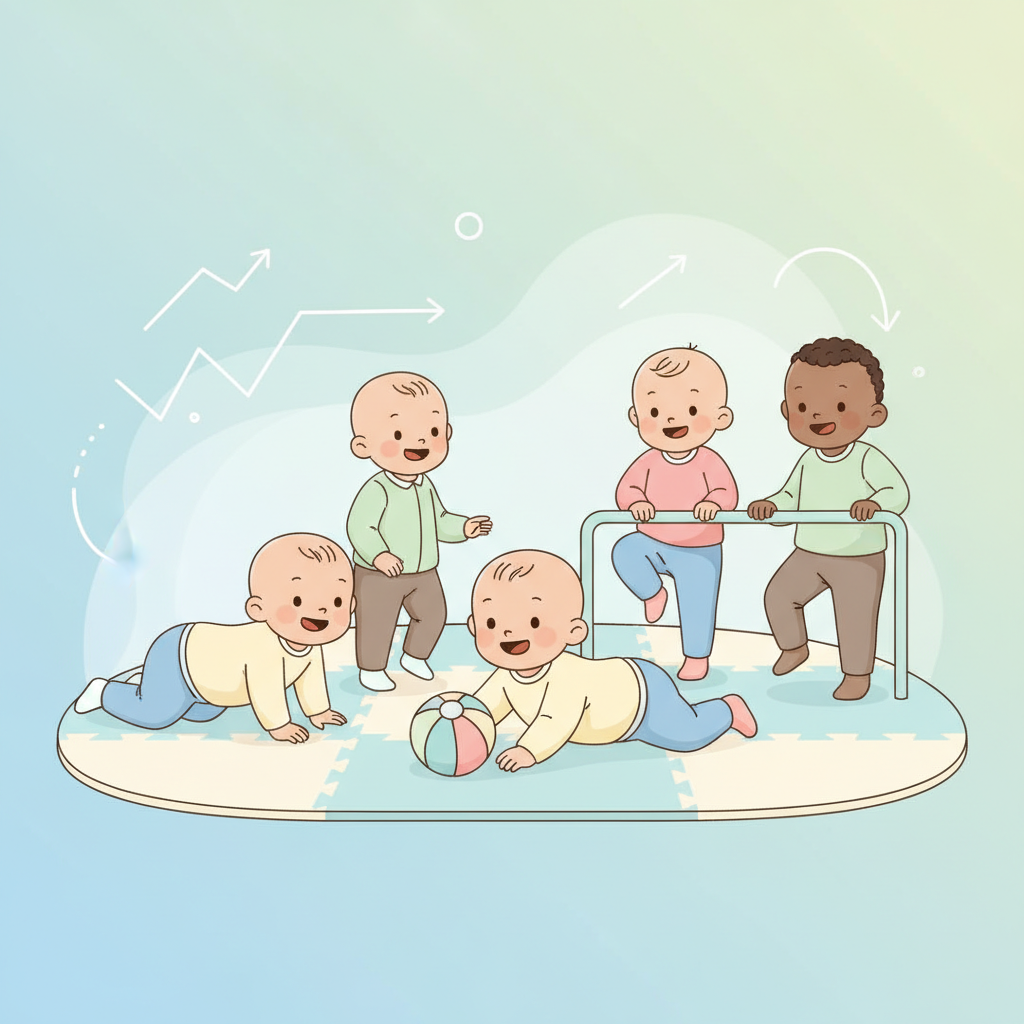
Tummy time is when the baby spends time on their stomach while awake and supervised. The answer to the question “When to start tummy time?” is usually: from the newborn period, starting with short and frequent attempts. The goal here is to strengthen the neck, shoulder girdle, and torso muscles to prepare the ground for head control and subsequent stages.
How many minutes of tummy time a day?
- In the first weeks: Start with 30-60 seconds, 3-5 times a day.
- At 2-3 months: Aim to gradually increase to 20-30 minutes in total (not at once, spread over the day).
- At 4-6 months: Time increases as your baby tolerates; the goal is “quality” prone time and active pushing/reaching.
Step-by-step tummy time exercises (applicable at home)
- Tummy time on chest: Your baby sees your face while on your chest; it is easier to calm down.
- Tummy time on knees: Lay the baby prone on your legs and give a slight incline.
- Rolled towel support: Release the shoulders with a thin rolled towel under the chest.
- Motivation with mirror: Looking in the mirror while prone can prolong head lifting.
- Moving the toy in a half-moon shape: Move the toy slowly left and right so they turn their head to both sides.
- Short sets, frequent repetition: 6-10 mini sessions are more effective than one long session.
What to do for a baby crying during tummy time?
- Shorten the duration, try more often during the day.
- Soften the surface but avoid surfaces that sink in too much (safety for breathing).
- Choose a moment when the baby is not hungry/very sleepy.
- Start with a more “close contact” position like tummy time on the chest.
Safety note: Tummy time is not done while sleeping. Always lay the baby in the safe supine sleep position when sleeping.
This section is designed to answer long-tail searches such as “tummy time exercises”, “how to do newborn tummy time”, and “how many minutes of tummy time a day”.
Baby Motor Development Games: Safe and Effective Play Plan for 0-12 Months
The most important principle for baby motor development games: less equipment, more repetition. Instead of expensive toys, a safe play area and correct guidance are more effective.
0-6 month baby activities (gross motor focused)
- Right-left symmetry game: Present the toy equally to both sides. This can reduce the tendency to turn to only one side.
- Rolling preparation: Reaching for a toy while lying on the side supports torso rotation.
- Not short “mini crunch”, but correct support: Instead of pulling the baby up by the arms to sit, encourage the transition to sitting by rolling sideways with play.
6-12 month baby activities (preparation for crawling and standing)
- Obstacle crawling course: Low obstacles with cushions, pillows, folded blankets.
- Carrying to target: Place the baby’s favorite toy 30-50 cm away; encourage moving forward.
- Cruising along furniture: Make holding areas safe by protecting sharp corners.
Home arrangement and safety (overlooked but critical)
- Do not make walker use a routine; it may increase the risk of falling and reduce natural movement experience.
- Remove choking hazards such as small toy parts, bags, and cords from the play area.
- Use a non-slip play mat on hard floors; however, very soft surfaces that sink in may make crawling difficult.
This game plan helps meet user intent in searches for “supporting baby development” and “things to do at home for baby motor development”.
If needed, if you are curious about the methods used within the pediatric approach framework, you can also check our What is Bobath Therapy (NDT) and Which Children is it Applied to? article.
When Should Specialist Support Be Sought? (Red Flags and Referral)
Every baby may progress at a different speed; nevertheless, some signs require evaluation without saying “let’s wait and see”. Consult your pediatrician and a specialist working in the field of pediatric physiotherapy/occupational therapy in the following situations:
- At 2-3 months: Distinct weakness in head control, unable to lift head at all in prone position
- At 4-6 months: Distinct asymmetry (constantly turning to the same side), using one arm/leg less
- At 6-8 months: great difficulty sitting even with support, excessive looseness or stiffness in the torso
- At 9-10 months: Very little desire to explore the environment via movement (no rolling/creeping), inability to transfer weight noticeably
- At every period: Visible regression (losing a skill they could previously do)
Especially if you notice a one-sided tendency in neck and head position, the Neck Curvature (Torticollis) in Babies and Physiotherapy Solutions content can be a guide. For early evaluation and referral in a broader framework, you can also review the What is a Risky Baby? Why Does Early Intervention Save Lives? article.